
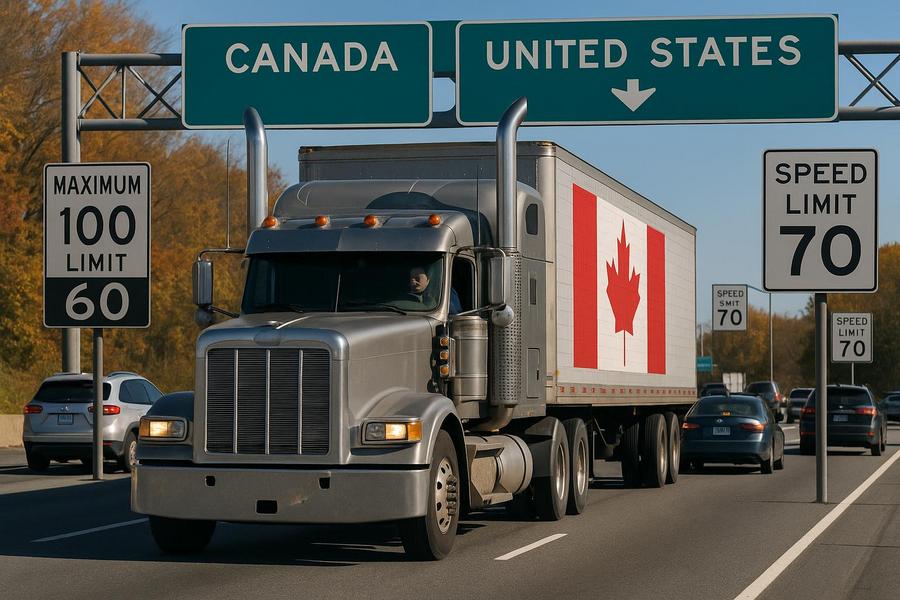
U.S. drops speed limiter proposal for heavy trucks, affecting cross-border insurance. The Federal Motor Carrier Safety Administration has abandoned plans to restrict truck speeds to 60-68 mph, a measure it had proposed twice since 2016.
The decision creates insurance implications for Canadian fleets operating across the border, where posted limits reach 70 mph or higher in several states, according to data on U.S. speed regulations.
“Among other factors, speed is considered part of the risk calculus for insurers,” says Eddie Staines, vice-president of Transportation & Specialty Auto at Intact Insurance Canada. “We know that higher speeds lead to reduced reaction times. This is a risk, as these larger and heavier vehicles require longer stopping distances.”
Insurance experts note that operating at higher speeds gives drivers less time to avoid road hazards or sudden traffic changes. The result can be severe losses including significant property damage and potential fatalities.
Staines highlights that telematics now provides real-time data on driver behavior. “Although a fleet operator may be following the law and not convicted for any speeding events, they may still exhibit risky behavior that could lead to potential losses,” he told Canadian Underwriter.
Even without federal speed limiters, truckers aren’t exempt from maintaining appropriate speeds. Insurance premiums remain based on multiple factors including claims history.
Beyond collision risks, higher speeds increase vehicle maintenance needs. “Increased friction and heat from the higher speeds on tires can cause them to wear down faster,” Staines explains.
For Canadian fleets operating in America, the regulatory difference creates a complex environment where both safety and insurance calculations must be carefully managed.